Metadata (Part 1): A Brief History
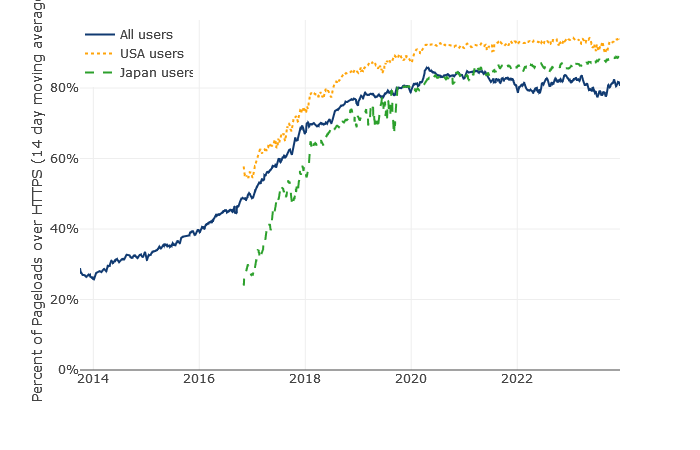
Over the years, Electronic Frontier Foundation (EFF)[1] pushed for encryption everwher through their HTTPS Everywhere browser extensions[2]. EFF states: Firefox reports that over 80% of the web is encrypted, and Google reports 95% over all of its services[3].
"Electronic Frontier Foundation (EFF)" https://www.eff.org/ ↩︎
HTTPS Everywhere. No longer required for major browsers as of 2021. See: https://www.eff.org/deeplinks/2021/09/https-actually-everywhere ↩︎
"The Last Mile". EFF. https://www.eff.org/deeplinks/2023/12/year-review-last-mile-encrypting-web ↩︎
Encryption of network data protects users across every network and resource we access everday from social media sites, to email, to banking and beyond. However, this does not just effect network data but also data at rest. Windows Bitlocker has been around 19 years and encrypts hard drives and files[1]. Mac OS supported their own encryption called FileVault in 2003[2]. Linux supports a bunch of encryption methods even earlier then Windows and Mac OS.
When everything is encrypted, metadata is where we might gleam an idea what information is "hidden". Metadata helps speedup searching large datasets.
Where did the term come from?
In the book Metadata Fundamentals for All Librarians[3], Caplan explains the term "METADATA" was coined by Jack E. Myers in the lat 1960s and trademarked in 1986. Myers used the trademark with his company the Metadata Company (now Metadata.io). Librarians, the World Wide Web Consortium (W3C), and others had varying descriptions of metadata in the 1990s. W3C defined it as "machine understandable information for the web" while the IFLA (International Federation of Library Associations) said it refers to "any data used to aid the identification, description and location of networked electronic resources".
Today, NIST defines it as Information describing the characteristics of data including, for example, structural metadata describing data structures (e.g., data format, syntax, and semantics) and descriptive metadata describing data contents (e.g., information security labels)"[4].
Where do we go from here?
I believe that metadata is somewhere in between these definitions. Most people today describe metadata as "data about data", but I think there is more to it. Metadata, sure, is about data but it "describes" but not just network resources. It can describe anything -- a person, a book, a place, or a word. If you were given the lat/long, country, and basic description of a some place but didn't have the name, one could surmise the correct location and get the place name using OSINT and research.
Metadata is structured data. It may not be in a specific machine structure (such as JSON, CSV, etc). I agree with the IFLA that card catalogs (remember those?) contained metadata about books and where to find them.
"Windows Bitlocker" https://en.wikipedia.org/wiki/BitLocker ↩︎
"Mac OS X FileVault" https://en.wikipedia.org/wiki/FileVault ↩︎
Caplan, Priscilla. "Metadata Funamentals for All Librarians." (2003) https://www.google.com/books/edition/Metadata_Fundamentals_for_All_Librarians/yt2863FismcC?hl=en&gbpv=1&pg=PA1&printsec=frontcover ↩︎
NIST. metadata. https://csrc.nist.gov/glossary/term/metadata ↩︎